
Just Lucky, I Guess
I’m grateful for serendipity, or whatever you want to call it


In the latest issue of The Economist (yes, I actually read The Economist), the Buttonwood columnist tells the story (paywalled) of how three University of Chicago economists in Errol Morris’ new film, “Tune Out the Noise,” took their academic ideas and applied them to actual economic markets, “providing the foundation for modern passive investing.”
But, the columnist notes, the film also makes a point about the value of chance — or, to be more precise, serendipity.
For example, Eugene Fama almost never made it to the University of Chicago at all, since his application had been lost. He calls the university, reaches a dean who tells him about a scholarship that’s perfectly tailored for him, and is told it’s his if he wants it.
Or Myron Scholes, who was one of seven people hired to do computer programming, a job he didn’t feel qualified for. The other six programmers don’t show up, Scholes likes the work, and is offered a slot in U of C’s doctoral program.
Or David Booth, who was going to be sent to Vietnam in 1969, but since he was pursuing a Ph.D., is waived by a draft officer.
“A few twists of fate — an unanswered phone call, a prickly recruiting officer, more diligent computer programmers … would have prevented some of the men from reaching Chicago,” Buttonwood writes.
What are the odds?
(Perhaps an economist can calculate them.)
I love this stuff. Growing up, one of my favorite shows was James Burke’s “Connections,” which showed how, for example, the concept of credit led to better-equipped armies, new military strategies, the problem of feeding large groups effectively, refrigeration, the thermos, and — finally — landing a man on the moon.
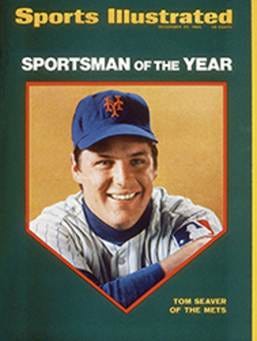
Or take something less dramatic but just as interesting. In 1965, Hall of Fame pitcher Tom Seaver, a California native, was drafted by his home-state Los Angeles Dodgers, but turned down their offer. A year later, the Atlanta Braves re-drafted him and offered him a contract that Seaver signed — but the contract was voided by Commissioner Spike Eckert because Seaver’s Southern Cal team had played two exhibition games that year. (Seaver didn’t even participate.) Due to the contract, though, the NCAA said Seaver couldn’t keep his amateur status, so he couldn’t play for USC, either.
Seaver’s father threatened a lawsuit, Eckert put Seaver’s rights up for bids in a lottery, and the New York Mets won the drawing against the Braves, Phillies, and Indians.
In 1969, the Seaver-led Miracle Mets, who had been the National League’s doormat since their founding in 1962, won the World Series. (I can hear my wife, a lifelong Cleveland fan, howling from here. Can you imagine a rotation of Sudden Sam McDowell, Luis Tiant, and Tom Seaver?)
Where do these chance events end and where does serendipity begin?
Depends on your point of view. Certainly, there are sudden turns of fortune that lead to loss and devastation. (See the 13th-century Mongols.) But one can argue — and I will! — that serendipity is sometimes making the best of an unplanned situation.
For example, one fall day in 1982 I was walking on the Emory University quad, where several campus organizations were soliciting new members. I stopped by a table for the College Bowl team — I’d played quiz bowl in high school, but had no idea there was a college level — fell into conversation with the coach, a bearded eccentric named Lloyd Busch, and the team’s sunny captain, Stan Keen. We bonded over pop music and reference books, and I figured I’d drop by a practice.
More than 40 years later, some of my old College Bowl colleagues are still my closest friends.
Or the Sunday in 1991 I arrived back in Atlanta, defeated by a try at life in New York. On a whim, some friends and I went to play Team Trivia at Manuel’s Tavern, won, and became regulars. A year later, I was hosting the show. Two years after that, I met my wife there.

OK, maybe it’s not serendipity. Maybe it’s all luck. Maybe it’s all happenstance. Maybe it’s all been planned out by some lifeform that’s running simulations with us as its subject. (Calling Douglas Adams!)
Hell, why bother to get all woo-woo about it. Maybe it’s just life.
Mine has been fortunate.
On Thursday, I celebrate 60 years. I’m grateful for it, good, bad, and inexplicable.
Years ago, I tried to help “Doc Hollywood” author Neil Shulman write a memoir. That went off track, but among his many observations, Neil made a wonderful point: we’re all here because a solitary sperm — out of a couple hundred million — made it to an egg and formed a zygote.
What are the odds?
I won’t even bother consulting with an economist on that.