
Between Two Zebras
A recap of the climb, with no way to know to know where I was or what was lurking; My cancer memoir, "Acknowledgments," continued


For new readers: More than a year ago, at the beginning of 2025, I told myself that I would finally write my cancer memoir. I had saved my posts and notes from the 15 months I went through treatment, and I was going to put it together into a book, even if only to prove that I could.
As a way of pushing myself, I’m posting chapters on Substack. The goal is to have a complete memoir, eventually. Each chapter will begin with one or more posts I made during treatment, followed by commentary. You can find earlier chapters at blockheadchronicles.substack.com, though you may have to hunt a bit, because I’ve gotten lazy about continuing the cancer story, instead writing about music, movies, baseball, and politics. You know: things that matter.
(Also: Cats.)
As with any project of this type, the writing is loosely edited and baggier than I’d like (and I’m someone who writes lots of baggy parenthetical interruptions, like this one). In fact, consider it a … second draft. Or a 1-1/2th draft. Something to keep in mind if you’re expecting a polished reading experience. This is more like a crusty lump of coal.
III. Pneumonia
Update, 12/1 a.m. digression (Facebook, December 1, 2021):
When I was a kid, my family would take long car trips. For breakfast, my mother often bought those Kellogg’s variety six-packs of single serving cereals.
Invariably, the last two to go — after the Rice Krispies, Frosted Flakes, Corn Flakes, and Froot Loops — would be Special K and Product 19.
All this to say, today I had Special K for the first time since I was maybe 11. They were out of Cheerios and that was the substitute.
A poor substitute.
-
Update, 12/1 p.m.:
Home. Discharged about 4 hours ago. Supposed to get an upgraded O2 concentrator after 7.
Numbers still decent. They had better stay that way. I will do my part.
But first, in honor of this morning’s popular cereal post (no relation to Post cereals), I’m gonna have a bowl of Frosted Flakes.
-
Update, 12/4 p.m.:
I’ve now been home from the hospital for three days.
I don’t need to tell you it was a sobering and humbling experience to go back to the hospital, and that I’m being overly wary and careful now that I’m out. Or I’m trying to, given that simply walking from point A to point B is enough to drop my oxygen a few points. Usually it comes back quickly, but sometimes I really need to sit.
I know there’s nothing I could have done about the pneumonia. Indeed, if you’re familiar with the medical phrase “horses vs. zebras” — “horses” being the common ailments with usually obvious diagnoses/cures, “zebras” being unlikely illnesses that usually lead down the wrong path of treatment — I’ve been hit with two zebras (or, at least, lesser-seen horses) this year.
The chylothorax (fluid) that filled my lung cavity earlier this year and accompanied my lymphoma is an uncommon symptom, particularly in people my age. I’m glad the urgent care doc did an x-ray, or who knows how long it would have gone undiagnosed?
Then came the pneumonia at, I hope, the other end of this process — radiation-related, high eosinophil pneumonia. I haven’t been able to get precise stats, but my brother ran across one that says it happens to fewer than 20% of patients (not sure if that’s cancer patients or the general public). Either way, again, not the obvious thing to look for.
So you’ll pardon me if I’m a bit paranoid and morbid right now. I really don’t want to be blindsided again, as much of a paradox that is. (If you’re thinking of how you can be blindsided, you’re not being blindsided.)
To put it bluntly, I don’t want to die. Not now. Not for at least 20 years. Longer, much longer, if possible. It can be a crummy world, but there’s a lot I want to see and more I want to do.
Listen: The prognosis is decent. (I’ll upgrade “decent” when I’ve had my appointment with the pulmonologist a week from Monday.) The prednisone is doing its job from what I can tell, and though those oxygen numbers dip when I exert myself, the heart rate is back where it should be — 60s and 70s at rest, without climbing to the stratosphere when I move.
But still, zebras. The unexpected. The unknown.
Several of you have had your own health scares. I know at least two friends who had heart attacks at young ages, and I can think of others who survived life-threatening issues. Feel free to comment here, or backchannel if you prefer, about how you moved from “wary” or “timid” after your release to when things approached normal again — and if you had unexpected setbacks to overcome. I could use the uplift.
We have a home health nurse coming this afternoon who will do an assessment of me and our house. I look forward to meeting her and working with her. The other home health nurse, who helped me through the chemo and fluid draining, has been a godsend. In fact, all the nurses I’ve met have been terrific.
Do not take nurses for granted. Nothing against doctors — and several of you are doctors, and I’m in awe of your expertise — but nurses are the literal lifelines of the medical profession.
Thanks for listening.
I feel it’s time for a recap.
By this point — early December, 2021 — I was about halfway through my treatment, beginning with diagnosis in late April 2021 and having the complications from having my lymphatic duct repaired a few months after these Facebook entries, in early summer of the next year.
It’s far from a straight line, and it would get bumpier. When I’ve taught language arts to my GED students, we do a lesson on the “story mountain,” the classic illustration of the rise and fall of plot action: exposition, rising action, climax, falling action, and resolution/denouement, complicated by conflicts, minor events, and smaller resolutions along the way.
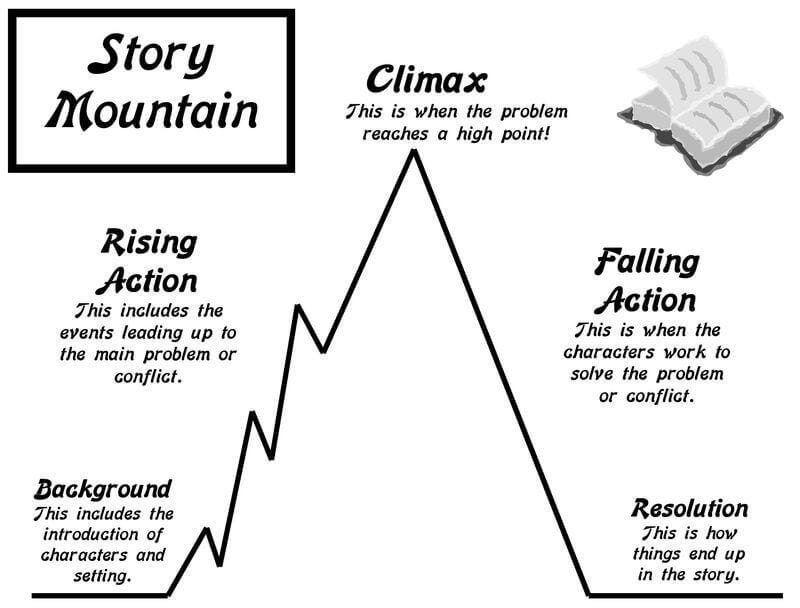
The nice thing about the story mountain is that it’s predictable, as are many things in hindsight. (Even my story. I’m here to tell it, right?) But when you’re going through it, you have no idea when you’ve finally hit the peak and are on the way down to the resolution.
This is around the point when I started wondering if I was ever going to get over the mountain. In April, I’d been diagnosed with lymphoma. From May through August, I went through chemo, with success. In September and October, I went through radiation, with more success.
And then came November, when I got pneumonia, had a brief hospital stay followed by a longer hospital stay, and emerged on 24/7 oxygen while still dealing with the regular chylothorax drainage and its medical accessories. It was now early December. Was this the way it was going to be?
My prognosis may have been decent, but I had no way of knowing if I was going to fulfill it. I had worries of being on oxygen the rest of my life. I had worries of having to sell our house because I was unable to climb stairs without becoming exhausted.
I had worries about being a burden.
I knew millions of people lived wonderful lives while having to rely on oxygen, or get around in wheelchairs, or having to make arrangements to do the most basic tasks. (I was about to require a nurse assistant to bathe.) But losing any degree of independence is never easy, and I was terrified of giving up more than I had.
My wife, S—, was ready to do what was necessary. But I didn’t want it to be necessary. I just had to keep climbing until I could see the other side.
"To put it bluntly, I don’t want to die. " The absolute truth. But I'm now imagining writing it, but not in the abstract.